The waiter has just set down two glasses of water. Across the table, the other person smiles and asks a harmless question about your week. And somewhere, without warning, something shifts. The date is no longer a meeting. It has become an assessment. You monitor the sound of your own voice, wonder whether the silence is dragging, already scan the face across from you for a flicker of disappointment. The conversation goes on, but part of your attention has pulled inward, busy grading you in real time.
Many atypical people know this exact moment. Not the nerves beforehand, not the shyness of the opening minutes. That denser feeling of being watched, sized up, compared, and of playing a game you could walk away from having lost. This article isn't about how to conquer that fear in order to seduce better. It's about understanding what's happening, because understanding the mechanism already changes how you live it.
It isn't shyness
We tend to lump several things together under the word "stress." There's stage fright, that quickening before a moment that matters, which fades once you're underway. There's shyness, a reserve in contact that doesn't really stop you from living. And then there's settled social anxiety, which works differently.
The British clinical guidelines (NICE) describe it as a marked fear of situations in which one may be observed, embarrassed, or judged, with avoidance of those situations and a real impact on social life and quality of life. The difference isn't only a matter of the fear's intensity or its impact, which count too. It lies above all in a particular structure: social anxiety is self-sustaining. Stage fright passes. Shyness eases through contact. Social anxiety, by contrast, runs in a loop: you avoid, so you never get to confirm that it might have gone fine, so the fear stays intact for next time.
Why romantic encounters concentrate everything
Few situations gather as many triggers as a date. Uncertainty first: do they like me, is it mutual, where do we stand. Then implicit evaluation, which covers everything at once, appearance, humor, conversation, how desirable you come across. The constant ambiguity of signals: a silence, a short message, a delayed reply, all of them blanks you fill in yourself, usually with the worst. And behind all of it, a matter of identity: if the other person turns away, what does that say about me.
A daily-diary study run at the University of Haifa and published in 2024 followed young adults with and without social anxiety disorder over three weeks, tracking their app use and their dates. The finding is telling: the two groups didn't differ much in how often they used the apps. What set the anxious participants apart was the aftermath. They felt far sharper spikes of shame and embarrassment tied to dating. Fear doesn't necessarily show in behavior. It lodges in what happens afterward, in the mind.
The core mechanism: watching yourself from the outside
This is the heart of the problem, and it's more precise than you'd think. The cognitive model of social anxiety, developed notably by Clark and Wells, describes a shift in attention. Instead of facing outward toward the other person and the situation, attention turns back on the self. You monitor yourself, scrutinize your own sensations, and treat them as visible proof of what the other person perceives. "I feel myself blushing, so it shows, so they notice, so this is going badly." The information comes from inside, and you process it as if a camera were trained on you.
Two things follow. First, you become partly unavailable to the other person: part of your mind is busy grading itself, and so less present to the actual conversation. Then come the safety behaviors, those strategies for not failing that end up feeding the problem. Over-rehearsing what you'll say, masking your reactions, overplaying ease, filling every silence at all costs. Each one feels protective. In reality, each one prevents you from finding out that you could have shown up as you are without disaster.
A filter often layers onto this mechanism: rejection sensitivity, the tendency to expect it, to detect it fast, to react to it hard. A meta-analysis by Mishra and Allen, published in 2023 in Personality and Individual Differences, pulled together the research on this trait in romantic relationships. People highest in rejection sensitivity report lower relationship satisfaction, less felt closeness, more conflict and jealousy, and a stronger tendency to go quiet, to efface themselves to avoid friction. The important point: these are correlations, not a fate. A pattern, not a sentence.
Neurodivergence: a vulnerability, not an equivalence
It would be wrong to say that neurodivergent people are socially anxious. Many aren't. But certain experiences common to these journeys raise the vulnerability, and they're worth naming.
A history of mockery, rejection, and repeated misunderstanding leaves traces: you learn to expect the worst. Years of social camouflaging, imitating the codes to go unnoticed, are exhausting and install the idea that you're only acceptable when masked. And that cost is measurable: a meta-analysis by Khudiakova and colleagues, published in 2024, gathered the studies on camouflaging in autistic people and found a clear link with higher anxiety, more depressive symptoms, and social anxiety in particular. Continuously masking who you are doesn't protect for long; it wears you down. The difficulty of decoding certain implicit signals, meanwhile, turns the ambiguity of dating into uncertain ground. And on top of it all, that stubborn fear of being "too much," weird, unfit, which trails many atypical people well before the first date. Classic courtship, with its blurry codes and games of façade, then demands an effort that tires before anything has even begun.
Apps: protection or trap
It's not all negative on the app side. For anyone who dreads direct contact, they offer time: time to think before replying, to filter, to set your own pace, to avoid the overload of a meeting launched too fast. That's a real benefit, especially when the unexpected is costly.
But the same tool can turn, and always by the same mechanism: it multiplies the chances to interpret a silence. An unanswered message, a profile that disengages, a lengthening delay, all blanks the anxious mind fills with the worst possible version. The constant comparison with the next profile adds its note, and the time spent polishing your own can become a refined way of avoiding the real thing. The point to keep is simple: apps reduce immediate exposure, they don't remove the fear of being judged. They shift the ground; they don't neutralize it.
From performance to safety
If the problem comes from attention turned back on the self and from avoidance strategies, then the way out isn't to become wittier, funnier, or smoother. It's to feel safe enough that you no longer have to monitor yourself.
A few directions, grounded in what research knows about the subject. Expose yourself gradually to social situations without aiming for perfection, so experience can confirm that imperfect goes over perfectly well. Spot your own safety behaviors, that over-control that reassures but isolates, and drop one now and then. Cut down on the post-date rumination, that looping replay that teaches nothing and only erodes. Choose contexts compatible with how you function rather than forcing yourself where you know you'll burn out. And learn to state your needs without endlessly justifying them, because a need set out clearly isn't a flaw to apologize for.
On the therapeutic side, these directions don't come from nowhere. The NICE guidelines place cognitive behavioral therapies specific to social anxiety among the reference treatments for adults. A controlled trial led by Clark and his team at King's College London even showed that targeted cognitive therapy produced better results than an exposure-and-relaxation approach: in that trial, conducted with 62 patients, 84% of participants in the cognitive therapy group no longer met the criteria for social phobia by the end of treatment, against 42% in the other group. The sample is small and the result doesn't transfer wholesale to everyone, but the direction is clear: what works isn't the effort of forcing yourself. It's the work on the way you watch yourself.
Meeting someone without betraying yourself
The goal was never to become someone perfectly confident, funny, charming, and fluent. That person doesn't exist, and chasing them only adds one more demand to a situation that already has too many.
The goal is humbler and truer: to be able to enter a relationship without reducing yourself to your fear, without masking everything, and without turning every interaction into an exam. Show a little, see what happens, try again. It's slow, it's imperfect, and that's exactly how the bonds that last get built.
When to seek help
Some signs are worth not facing alone: massive avoidance of dating, suffering that drags on, panic attacks, an isolation that settles in, rumination that stretches over several days, or the sense that you can no longer form a bond at all. In those cases, psychological support can genuinely help, especially approaches centered specifically on social anxiety. It isn't an admission of weakness. It's a way of taking the reins back.
Further reading
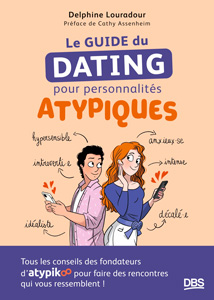
Delphine Louradour, co-founder of Atypikoo, has devoted an entire book to this subject: Le guide du dating pour personnalités atypiques (De Boeck Supérieur, 2026). It offers concrete tools for taming the intensity, the sensitivity, and those fears that sometimes sabotage the early stages of a relationship, without ever asking you to deny who you are.
References
NICE (National Institute for Health and Care Excellence). Social anxiety disorder: recognition, assessment and treatment (CG159).
Shechter Strulov, T. & Aderka, I. M. (2024). Dating in social anxiety disorder: A daily diary study. Journal of Anxiety Disorders, 107, 102927.
Clark, D. M. & Wells, A. (1995). A cognitive model of social phobia. In Heimberg, Liebowitz, Hope & Schneier (Eds.), Social Phobia: Diagnosis, Assessment, and Treatment.
Clark, D. M., Ehlers, A., Hackmann, A. et al. (2006). Cognitive therapy versus exposure and applied relaxation in social phobia: A randomized controlled trial. Journal of Consulting and Clinical Psychology, 74(3), 568-578.
Mishra, M. & Allen, M. S. (2023). Rejection sensitivity and romantic relationships: A systematic review and meta-analysis. Personality and Individual Differences, 208, 112186.
Khudiakova, V., Russell, E., Sowden-Carvalho, S. & Surtees, A. D. R. (2024). A systematic review and meta-analysis of mental health outcomes associated with camouflaging in autistic people. Research in Autism Spectrum Disorders, 118, 102492.