
Research and community surveys consistently document barriers that neurodivergent adults can face in dating, including implicit communication, sensory overload, masking, and difficulty finding compatible people locally. These needs have encouraged the development of specialized services. In 2025-2026, three visible platforms illustrate different approaches: Hiki, which reports nearly 200,000 users worldwide; Atypikoo, a French-speaking pioneer with 60,000+ cumulative registrations; and Mattr, a UK platform reporting approximately 10,000 users. Each addresses people with ASD, ADHD, high intellectual potential, high sensitivity, or other neurodivergent profiles in a different way.
Market Overview and Platform Positioning
The dating app market for neurodivergent people has developed since 2019 around different models: some services began with an autism-specific audience, while others address a broader neurodivergent spectrum. The frequent overlap between autism, ADHD, dyslexia, and other profiles also means that audience boundaries are rarely clear-cut.
Geographic distribution reveals contrasting dynamics. Hiki reports the largest international reach of the three. Mattr remains primarily focused on the UK, particularly London. French-speaking Europe is Atypikoo's established market, with a community concentrated in France, Belgium, Switzerland, and Quebec. Local member density remains an important consideration on every platform.
| Platform | Origin | Launch | Users | Target Audience | Dating/Friendship | Main USP |
|---|---|---|---|---|---|---|
| Hiki | USA | 2019 | Nearly 200,000 (self-reported) | ASD, ADHD, neurodivergent | Both | Largest global neurodivergent app |
| Atypikoo | France | 2019 | 60,000+ cumulative registrations | Gifted, ASD, ADHD, HSP, DYS | Both + professional networking | Complete social network + IRL events |
| Mattr | UK | 2023 | ~10,000 (reported in 2025) | Neurodivergent-friendly | Dating + IRL experiences | Mindful dating, mental health check-ins |
Why Specialized Platforms Matter: The Data
The 2026 Atypikoo Survey of 1,136 self-selected neurodivergent respondents helps explain the appeal of specialized platforms. In this sample, 85% rated mainstream apps between 1 and 4 out of 10 for meeting their needs, 73% reported being bothered by ambient noise, 80% disliked small talk, and 53% struggled to decode interest signals. The survey also found that 92% had experienced ghosting and 48% had considered giving up on love because of discouragement. These results describe the respondents to Atypikoo's survey; they should not be generalized to every neurodivergent adult.
In-Depth Analysis of Market Leaders
Hiki: The Largest Platform for Neurodivergent
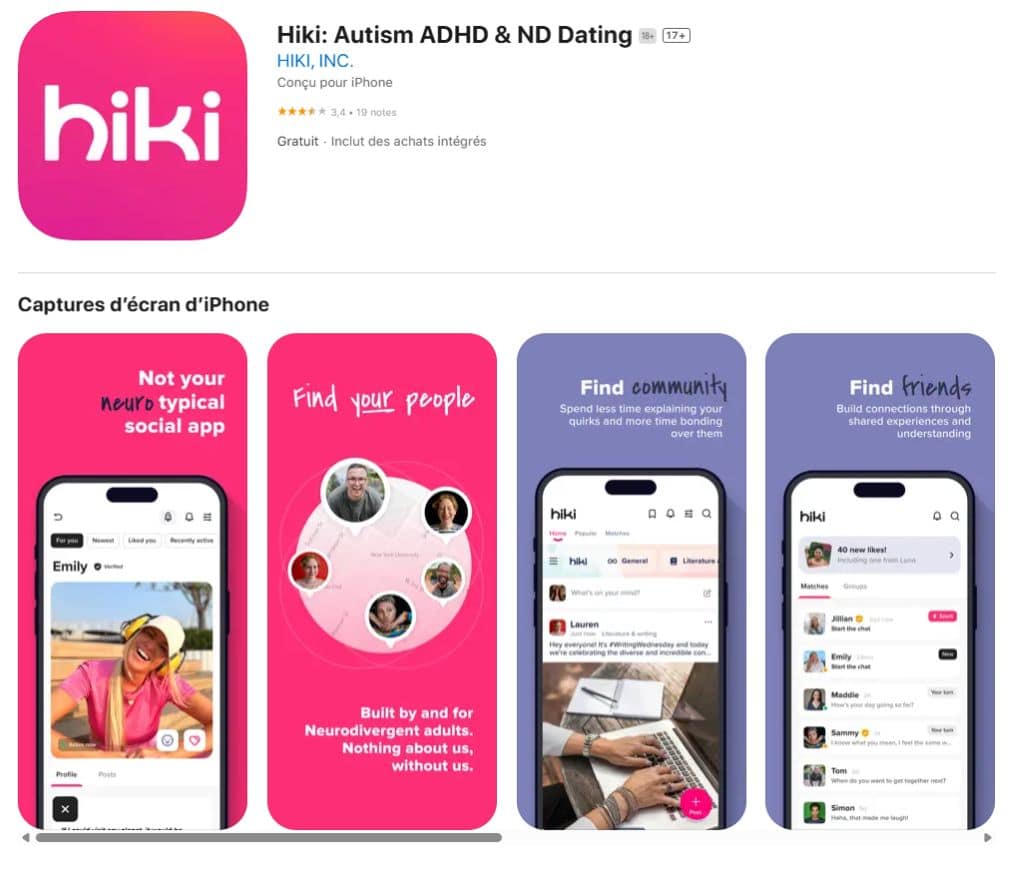
Founded by Jamil Karriem in 2019, Hiki reports nearly 200,000 users worldwide. Its current App Store listing supports 22 languages. The application has raised $7.22 million from investors including Techstars, Precursor Ventures, and the Disability Opportunity Fund. Hiki reports that its 2023 partnership with Getty Images (#AutisticOutLoud) generated 35 million views and 50,000 new users.
Hiki states that its team is entirely neurodivergent. The app uses a dual matching system: the heart button for romantic interest and the smile button for friendship. Its community feed allows users to post, comment, and react, extending the experience beyond dating. Hiki also offers reporting and blocking tools, moderation, and ID verification for Premium profiles.
Target audience: Originally launched for autistic people, Hiki now welcomes anyone who identifies as neurodivergent, including people who are professionally diagnosed, self-identified, or still exploring that identity. This broad approach maximizes inclusion. Atypikoo takes a more focused approach around autism, ADHD, giftedness, high sensitivity, and dyslexia; the best fit therefore depends partly on the community a user is looking for.
Hiki combines a Premium subscription with optional in-app purchases. Prices vary by storefront and offer. In July 2026, the French App Store listed:
- Hiki Premium: €5/week, with monthly offers listed at €15 or €34
- Boosts: €89 for 5
- Sparks: €17.99 for 3, €49.90 for 12, or €100 for 50
Sparks and Boosts are optional purchases, so there is no single defensible "real monthly cost" for Hiki: expenditure depends on the subscription offer and individual usage. The directly comparable point is the recurring entry price: Atypikoo's annual Owl plan is equivalent to €6/month, while the French App Store lists Hiki Premium from €15/month. Hiki's official FAQ confirms that Sparks and Boosts are purchased separately, and the App Store listing displays the current prices. Some user reviews and the NeuroHub Community investigation criticize the affordability of this structure.
Atypikoo: The Complete Ecosystem Alternative
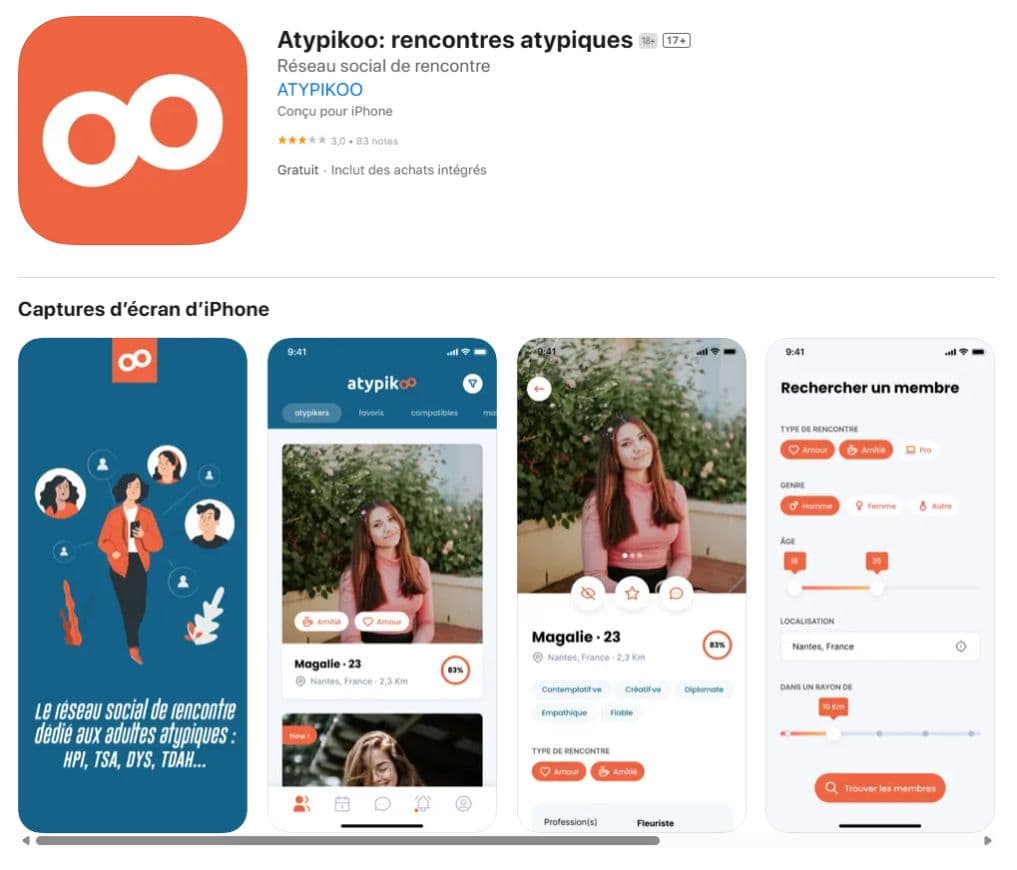
Launched in May 2019 by David Boudjenah, Atypikoo reports that it attracted 1,000 registrations during its first month, initially through word of mouth and without a paid marketing budget. The platform has since passed 60,000 cumulative registrations, with a community concentrated primarily in France, Belgium, Switzerland, and Quebec.
Target audience: Atypikoo centers its community on autism, ADHD, giftedness/high intellectual potential, high sensitivity (HSP), and dyslexia. This narrower positioning is intended to bring together people who recognize themselves in related experiences while still allowing each member to describe their identity and needs individually.
Atypikoo combines romantic dating, friendships, events, editorial resources, and professional networking. The platform reports more than 5,000 member-created IRL events since 2021 and more than 20,000 recorded participations; participation in community events does not require Premium. This responds directly to the 2026 Atypikoo Survey, in which 41% of respondents selected events designed for neurodivergent people as a desired solution and 47% preferred parks or outdoor walks for first dates. Four self-assessment tests, more than 250 published articles across supported languages, and a directory of 350+ listed professionals extend the service beyond dating.
Atypikoo's member base contains more women than men, and its largest age groups are adults in their thirties and forties. Pricing is particularly competitive among the three platforms compared here. The public subscription page lists three recurring durations, alongside separate non-recurring offers:
- Atypiker Zebra: €36 for 3 months (€12/month)
- Atypiker Panda: €60 for 6 months (€10/month)
- Atypiker Owl: €72 for 12 months (€6/month)
- Atypiker Unicorn: €96 for one year, without automatic renewal, including 4 self-assessment tests
- Atypiker Forever: €270 as a one-time payment, including 4 tests, for access while the Atypikoo service continues to operate
At a monthly equivalent of €6 when billed annually, Atypikoo has a lower recurring entry price than Hiki Premium's €15/month App Store offer. It also combines dating with IRL events, educational content, the Lylia AI relationship coach, and professional networking. Over 9,000 members have already chosen Premium.
Funding: Atypikoo is self-funded and bootstrapped, without external investors. Its model combines a functional free tier with fixed-duration Premium plans; communication, privacy, visibility, and community features are bundled instead of being sold as individual interactions. This supports transparent pricing while subscriptions fund development, moderation, support, and infrastructure.
Mattr: The Inclusive Newcomer
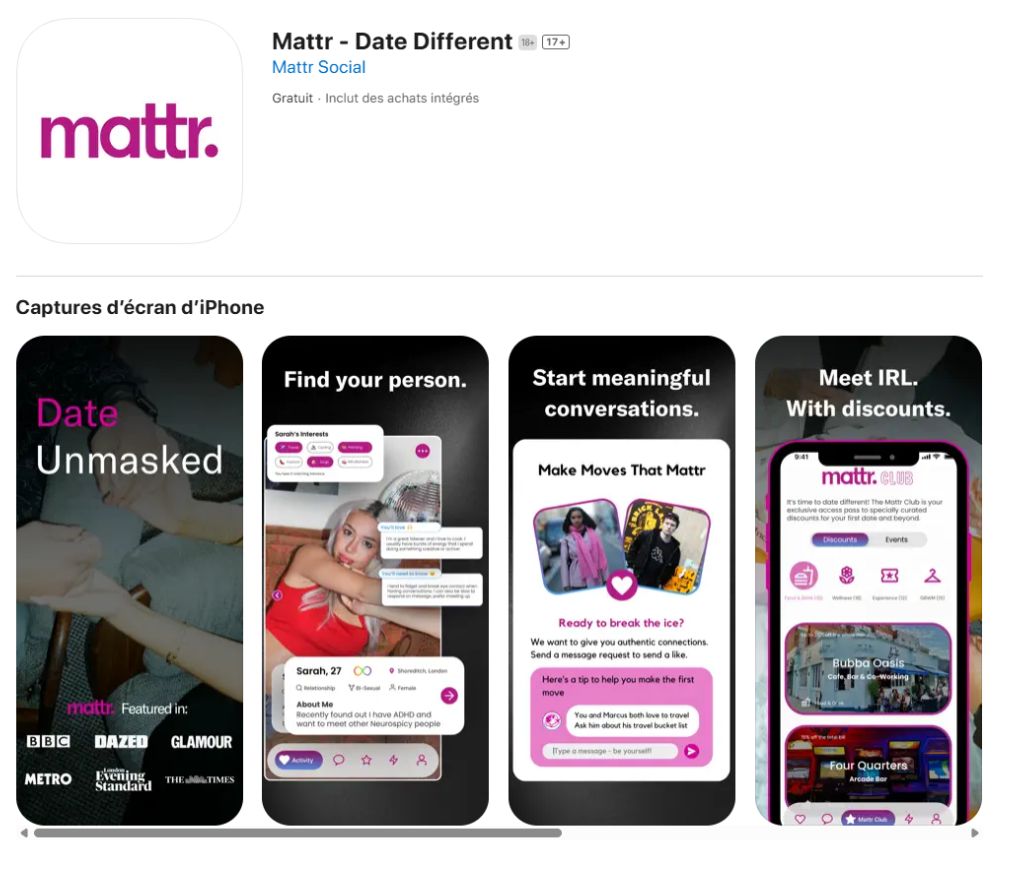
Created by Jamie Johnston, an entrepreneur diagnosed with ADHD and dyslexia in early 2021, Mattr positions itself as the UK's "first neurodivergent-friendly dating app" since its 2023 launch. Unlike Hiki and Atypikoo which are exclusively for neurodivergent people, Mattr is open to all users with features designed to accommodate neurodivergent needs—a "mainstream with accommodations" approach.
Mattr reported approximately 10,000 users in 2025, up from 2,000 active users and 4,400 downloads reported in March 2024. The service has since expanded across the UK, although its brand, events, and partnerships remain strongly associated with London.
Mindful Dating Philosophy: The concept of "mindful dating" limits daily matches to 7-9 profiles to reduce cognitive overload. The daily check-in system tracks mood, the "Time-out toggle" supports breaks, and matches expire after 7 days. The "Vibe Meter" is designed to encourage engagement rather than rapid swiping. Identity verification is intended to reduce fake profiles, but no verification system can guarantee that every profile is genuine or safe.
This "slow dating" approach aligns with broader 2024-2026 industry trends toward anti-burnout features and mental health integration—Mattr applies these principles with particular sensitivity to neurodivergent needs while remaining accessible to neurotypical users seeking more intentional connections.
Business model: Mattr Club gives members discounts with UK hospitality, wellness, fitness, and experience partners, alongside access to members-only IRL events. This is a different model from Atypikoo's larger member-created events programme. Mattr also hosts mixers and discussion panels.
Funding: Mattr reports backing from angel investors with experience at companies including Bumble, Depop, Google, Bain & Company, and Ada Ventures. It has also used community crowdfunding to support geographic expansion and product development.
The UK App Store currently lists Mattr at £21.99/month or £54.99 for 3 months, equivalent to approximately £18.33/month on the longer plan.
User experience varies by platform: Mattr's UK iOS rating remains positive overall, while recent Android reviews report loading, registration, and account-management problems. Store ratings are shown below with their region and verification date.
Detailed Pricing Comparison
Predictable pricing matters because autistic and ADHD adults can face substantial employment and income barriers, although published employment estimates vary widely by country, sample, and definition. Atypikoo uses fixed-duration plans starting at €36, with its lowest monthly equivalent at €6/month when billed annually. Hiki combines Premium subscriptions with optional Sparks and Boosts, so its total cost depends on individual usage.
Headline Pricing
| Platform | Free Tier | Lowest Monthly Equivalent | Other Listed Option | Pricing Structure |
|---|---|---|---|---|
| Atypikoo | Unlimited replies, 3 matches/month, all events free, Love Coach (20/mo) | €6/month (Owl, billed annually) | €72/year (separate Forever offer: €270) | Fixed-duration Premium plans |
| Mattr | Profile, 9 curated profiles/day, check-ins, brand perks | £18.33/month (via 3-month plan) | £21.99/month | Subscription |
| Hiki | 5 likes/day, community feed, 1 message per like | From €15/month on the French App Store | €5/week; other prices vary by offer | Premium subscription + optional purchases |
Hiki Premium and Optional In-App Purchases
Hiki offers a Premium subscription and also sells Sparks and Boosts separately. Its website explains the features, while storefront listings provide the region-specific prices. The French App Store displayed the following prices in July 2026:
| Hiki In-App Purchase | What It Does | Listed Price | Other Listed Price |
|---|---|---|---|
| Hiki Premium | Subscription including a verified badge and other Premium features | €5/week | Monthly offers at €15 or €34 |
| Boost | Temporary increased visibility | Optional purchase | €89 × 5 |
| Spark | Strong interest signal to another user | €17.99 × 3 | €49.90 × 12 or €100 × 50 |
These add-ons are optional and are not a valid basis for claiming that every active Hiki user pays the same monthly amount. For a like-for-like recurring-price comparison, Atypikoo's €6 monthly equivalent is 60% lower than Hiki's €15 monthly offer. Actual Hiki expenditure can be higher when a member buys Sparks or Boosts.
Side-by-Side: What €6/Month Gets You
| Feature | Atypikoo Premium (€6/mo) | Hiki (Premium + optional purchases) |
|---|---|---|
| Contact all members | ✅ Unlimited | Match requests subject to the applicable plan limits |
| Reply to messages | ✅ Unlimited | ✅ After mutual match |
| Boost visibility | ✅ Included | Available as an optional in-app purchase |
| Verified profile badge | ✅ Manual verification (free) | Included with Hiki Premium |
| AI Love Coach | ✅ Expanded monthly allowance with Premium | No comparable feature advertised |
| Invisible/incognito mode | ✅ Included | No equivalent feature advertised |
| IRL events | ✅ 5,000+ events, all free | No equivalent organized-events programme advertised |
| 250+ educational articles | ✅ Full access | Community feed; no comparable magazine advertised |
| Self-assessment tests | ✅ 4 tests included with Unicorn and Forever | No comparable tests advertised |
| Total monthly cost | €6 equivalent on the annual plan | Premium from €15/month; optional extras vary |
Premium features vary considerably across platforms. Hiki combines a Premium subscription with separately sold Sparks and Boosts. Atypikoo's standard Premium plans bundle communication, visibility, privacy, and community features; its Unicorn and Forever offers also include four self-assessment tests. Mattr focuses on partner perks and mindful-dating features.
Technical Features and Matching Algorithms
Matching Systems: From Special Interests to Compatibility Testing
Unlike mainstream apps focused on photos, neurodivergent platforms prioritize matching by special interests, personality, and neurological compatibility. Atypikoo calculates a score based on distance, age, relationship type, and character traits. Hiki cross-references interests, communication preferences, and support needs.
Atypikoo Matching Algorithm:
- Distance proximity
- Age compatibility
- Relationship type alignment
- Personality traits (from tests)
- Neuroatypicality type (ASD, ADHD, gifted, HSP)
Hiki Matching System:
- Special interests overlap
- Communication preferences
- Support needs compatibility
- Neurotype awareness
- Gender and orientation preferences
Mattr Approach:
- Personality-based matching
- Daily mood consideration
- Vibe Meter score
- Limited exposure (9 profiles/day) for thoughtful decisions
Neurodivergent-Specific Profile Fields
| Platform | iOS | Android | Web | ND-Specific Fields | IRL Events | Verification |
|---|---|---|---|---|---|---|
| Hiki | ✅ | ✅ | ❌ | ND traits, support needs, communication preferences | No | ID + location |
| Atypikoo | ✅ | ✅ | ✅ Full | Gifted, ASD, ADHD, DYS, HSP, HPE + MBTI tests | ✅ 5,000+ events | Manual 1-3 days |
| Mattr | ✅ | ✅ | ❌ | Optional "You'll need to know" section | ✅ London | Facial verification |
Atypikoo distinguishes itself through detailed profile fields, including the mandatory section "What makes you atypical?", and four integrated self-assessment tests. This provides particularly granular information about neurotype and personality.
Accessibility: Continuous Improvement
Accessibility documentation varies by platform. Hiki's current App Store listing declares support for VoiceOver, a dark interface, and sufficient contrast. Mattr and Atypikoo do not currently provide an equivalent formal accessibility declaration in their App Store listings. Developer declarations are useful indicators, but they are not substitutes for an independent accessibility audit.
Atypikoo continuously works on improving accessibility and user experience, with ongoing development focused on neuroatypical user needs. The platform has prioritized hiring neurodivergent developers to ensure authentic understanding of community requirements.
User Satisfaction and Technical Quality
Ratings and Reviews: Price and Technical Quality
| Platform | iOS Rating | Android Rating | User Strengths | User Weaknesses |
|---|---|---|---|---|
| Hiki | 3.3/5 (28, France) | 3.0/5 (3,760) | Safe space, community, less alone | High pricing, billing problems |
| Atypikoo | 3.2/5 (118, France) | Rating not displayed | Unique concept, events, kindness, complete ecosystem | Mobile app less developed than website |
| Mattr | 3.6/5 (192, UK) | 1.4/5 (68) | Simple interface, customer service | Frequent crashes, persistent bugs |
Ratings checked on July 20, 2026 using the French App Store listings for Hiki and Atypikoo, the UK App Store listing for Mattr, and their Google Play listings. App Store ratings are country-specific and all ratings can change over time.
Positive testimonials converge on a central theme: finally feeling "normal." A Hiki user describes the app as "a comforting weighted blanket." On Atypikoo, members celebrate "finding their tribe" and "deep conversations without small talk." These reviews illustrate the appeal of dedicated spaces where users feel less pressure to mask.
User feedback across platforms highlights common challenges:
- Pricing: Some Hiki reviews criticize the cost of Premium and optional purchases; Atypikoo has the lowest recurring monthly equivalent among the three plans compared here
- Technical: Recent Mattr Android reviews report loading, registration, and account-management problems
- Density: Regional user density varies, with metropolitan areas having more active communities
Which Platform is Right for You?
Based on the 2026 Atypikoo Survey findings and platform features, here's a quick guide to choosing the best fit for your profile:
| Your Profile | Suggested Fit | Why |
|---|---|---|
| Autistic seeking relationship | Atypikoo | Detailed profiles, transparent pricing from a €6 monthly equivalent, and community events that do not require Premium. Hiki has a larger international user base and may offer better local density in some countries, but its Premium subscription starts at a higher recurring price in the French App Store. |
| ADHD seeking connections | Atypikoo or Mattr | Atypikoo's structured format, personality tests, and IRL events help focus — plus the Love Coach AI provides personalized guidance. Mattr's limited daily matches (7-9) prevent overwhelm. Avoid Hiki if sensitive to high pricing or micro-transaction friction. |
| Gifted/HSP (any language) | Atypikoo | Among these three services, Atypikoo is the one that most explicitly addresses gifted and highly sensitive profiles and offers related self-assessment tests. It is available in French, English, and Spanish. |
| LGBTQ+ neurodivergent | Hiki or Atypikoo | Hiki offers a wide range of gender and orientation options and states a zero-tolerance discrimination policy. Atypikoo also welcomes all orientations and has a lower recurring entry price. Local community density and the available identity fields should guide the choice. |
| Friendship only | Atypikoo | Atypikoo's 5,000+ member-created IRL events provide concrete platonic meeting opportunities without requiring Premium. Hiki also offers a friendship mode and allows free users to chat after a mutual match, while Premium and optional purchases add other features. |
| Very limited budget | Atypikoo free tier | Reply to messages, participate in community events without Premium, use the Love Coach 20 times/month, and contact 3 matches/month. If budget allows, the Owl plan at €72/year (€6/month) unlocks the core Premium benefits. |
Key Takeaway: Atypikoo offers particularly strong value for people seeking more than swipe-based dating. Its Owl plan costs €72/year, equivalent to €6/month, which is 60% below Hiki's €15 monthly App Store offer. It also combines member-created IRL events, 250+ published articles across supported languages, the Lylia AI relationship coach, professional networking, and optional self-assessment tests. Hiki retains the advantage of a larger international user base, so local density should remain part of the decision.
Conclusion: Three Distinct Approaches to Neurodivergent Dating
Hiki, Atypikoo, and Mattr represent three philosophically different approaches to addressing neurodivergent dating needs:
Hiki follows a venture-backed growth model, with $7.22M reported as raised and the largest self-reported international user base of the three platforms. It monetizes through Premium subscriptions alongside optional Sparks and Boosts. This provides flexible purchases but can make the total cost less predictable; some users and advocacy writers have criticized its affordability.
Atypikoo represents the community-first, bootstrapped alternative: events, editorial content, professional services, and a recurring Premium price as low as €6/month when billed annually. Over 9,000 members have chosen premium, and the platform reports 5,000+ member-created IRL events with more than 20,000 recorded participations. Among the three services compared here, Atypikoo has the most developed documented in-person-events programme. Its audience contains more women than men, an unusual balance for a dating service, although that statistic alone does not prove safety or satisfaction. Independent ownership allows Atypikoo to use fixed plans without per-message charges or separately sold Sparks and Boosts.
Mattr takes a mindful, inclusive approach, combining limited daily profile suggestions, well-being features, brand partnerships, and members-only events. The platform is open to neurodivergent and neurotypical users across the UK. Its main challenges are building sufficient local density and resolving the technical problems reflected in recent Android reviews.
For the neurodivergent dating market to fulfill its potential, platforms must balance three imperatives: (1) accessible and predictable pricing, (2) technical quality adapted to neurodiverse UX needs, and (3) sufficient local user density for viable matching. Atypikoo performs particularly well on the first point and offers the broadest mix of dating, community content, professional networking, and free in-person events among the three platforms compared here.
Estimates of neurodivergence in the general population vary substantially depending on which profiles and definitions are included. As Atypikoo expands its English and Spanish versions, it brings an established French-speaking community model to new markets. Its main challenge will be building enough local density while preserving the accessible pricing and community features that differentiate it.
Frequently Asked Questions
Why do neurodivergent people struggle with mainstream dating apps?
According to the 2026 Atypikoo Survey of 1,136 neurodivergent individuals:
- 85% rate mainstream apps (Tinder, Bumble, Meetic) between 1-4/10 for meeting their needs
- 31% stopped using apps due to superficial interactions
- 73% are bothered by ambient noise during typical bar/restaurant dates
- 53% have difficulty decoding interest/disinterest signals
- 80% hate small talk, yet it's expected in conventional dating
- 42% fear being "too much" when being authentic
Mainstream apps optimize for neurotypical interaction patterns: photo-first browsing, quick judgments, implicit communication, and sensory-overwhelming date venues.
What is the best dating app for autistic people in 2025-2026?
Atypikoo offers the broadest ecosystem in this comparison, with a €6 monthly equivalent on its annual plan, expanded access to the Lylia AI relationship coach, visibility tools, and 5,000+ member-created IRL events. Hiki reports the largest international user base and combines Premium subscriptions from €15/month on the French App Store with optional Sparks and Boosts. Mattr suits UK-based users seeking a mindful-dating approach at approximately £18.33/month on its three-month plan. For users on limited budgets, Atypikoo's free tier includes message replies and event participation.
Are there free dating apps for ADHD?
No app targets ADHD specifically, but Hiki and Atypikoo both offer functional free versions with limitations. Hiki provides chat after mutual matches; Atypikoo allows unlimited message replies and event participation with 3 matches/month. Both accept all neurodivergent identities including ADHD.
Are neurodivergent dating apps safe?
All three platforms implement security measures: manual profile verification (Atypikoo), ID verification (Hiki), facial verification (Mattr), and zero-tolerance policies. However, the 2026 Atypikoo Survey revealed concerning statistics: 27% of neurodivergent people have experienced abusive or non-consensual relationships (38% of women vs. 10% of men). Platforms address safety but cannot eliminate all risks—users should prioritize slow disclosure, meet in public, and trust their instincts.
Can I use these apps without an official diagnosis?
Yes. These platforms accept self-identification: professional diagnosis, self-diagnosis, or exploration of neurodivergent identity. The 2026 Atypikoo Survey found that 55% had never revealed their neurodivergence to past partners, suggesting that many respondents were still discovering or navigating their identity.
Which app offers in-person events?
Atypikoo reports 5,000+ member-created IRL events since 2021, with participation available without Premium. Formats include meetups, hikes, escape games, and trips. This directly addresses the 41% of Atypikoo Survey respondents who selected events designed for neurodivergent people as a desired solution. Mattr organizes mixers and panels in London. Hiki does not currently advertise an equivalent organized-events programme.
Are these apps suitable for highly sensitive people (HSP)?
Atypikoo explicitly targets highly sensitive people (20-30% of members identify as HSP). The 2026 survey found 59% have been told they're "too sensitive" and 73% are bothered by ambient noise. Atypikoo's outdoor-focused events (47% prefer parks for first dates) and quiet venue recommendations address HSP needs. Mattr's mental health check-ins and time-out toggle also benefit HSP users.
How much do neurodivergent dating apps cost?
Pricing varies dramatically — and headline prices can be misleading:
- Atypikoo: €36/3 months, €60/6 months, or €72/year; separate Unicorn (€96) and Forever (€270) offers include four tests
- Mattr: £21.99/month or £54.99 for 3 months
- Hiki: Premium listed from €5/week or €15/month on the French App Store, with optional Sparks and Boosts sold separately; prices vary by storefront and offer
For context, 48% of respondents to the 2026 Atypikoo Survey said they had considered giving up on love because of discouragement. Employment outcomes for autistic adults also remain substantially less favorable than for the general population, although estimates vary widely. Transparent and predictable pricing is therefore an important accessibility consideration.
Reading from the UK?
The platforms above all serve UK users, but availability, local density and pricing differ. We cover the British landscape in detail — including disability-inclusive UK services and the meetup route — in our dedicated guide: the best neurodivergent & autism-friendly dating apps in the UK (2026).
About the 2026 Atypikoo Survey
Methodology: Online survey conducted in January 2026
Sample Size: 1,136 neurodivergent respondents
Profiles: 59% highly sensitive (HSP), 41% diagnosed gifted/HPI, 20% autistic spectrum (ASD), 18% ADHD
Demographics: 53% women, 44% men, 2% non-binary
Age Range: Majority 35-54 years (64%)
Geographic Focus: Primarily French-speaking (France, Belgium, Switzerland, Quebec)
This survey represents one of the largest quantitative studies on neurodivergent dating experiences, providing empirical evidence for platform design decisions and community needs.